Wednesday, September 21, 2011

Impressions from a Hellenic summer


Syracuse: what a sparkling, spacious, airy Hellenic city! The Greek part of Sicily, from Selinus through Acragas and Syracuse to Tauromenium, exhibits an unadulterated historical magic that on pinions of pure feeling carries you back to that superb age of archaic finesse and cruelty which is the root of the European spirit. My visit was a baptism in lofty meditation that -temporarily- cleansed the soul of the muck of pettiness and foreboding that is its fate in the sorry place to which it has since returned.

The sun was sharp as, from the top of Archimedes' fortress, Eurylaeum, I surveyed the plain surrounding that natural wonder which is the port of Syracuse. In the play of hues and shadows in the distance it was as if that sublime confrontation, in which the sea pride of the foolish Athenians was reduced to so much floating timber, was being reenacted for my sake. Nobody else, though, saw what I saw.

When I eventually got to the port there was a big summer fire burning on the other side in the vicinity of the temple of Zeus. Nobody seemed to bother much -simply because, I think, it posed no threat to the landscape and its cultural identity. This is a fearless land, one in which through untold vicissitude and upheaval the brightness of its Hellenism has always managed to shine through. What was more impressive was how aware the locals were of these demons still inhabiting their portion of the earth and how they sought their company.

When she was informed that we came from Greece, our guide at Selinus had earlier simply said: "welcome home". This to me was like a potion of divine youthfulness running through the veins, a precious gift that I will always cherish.

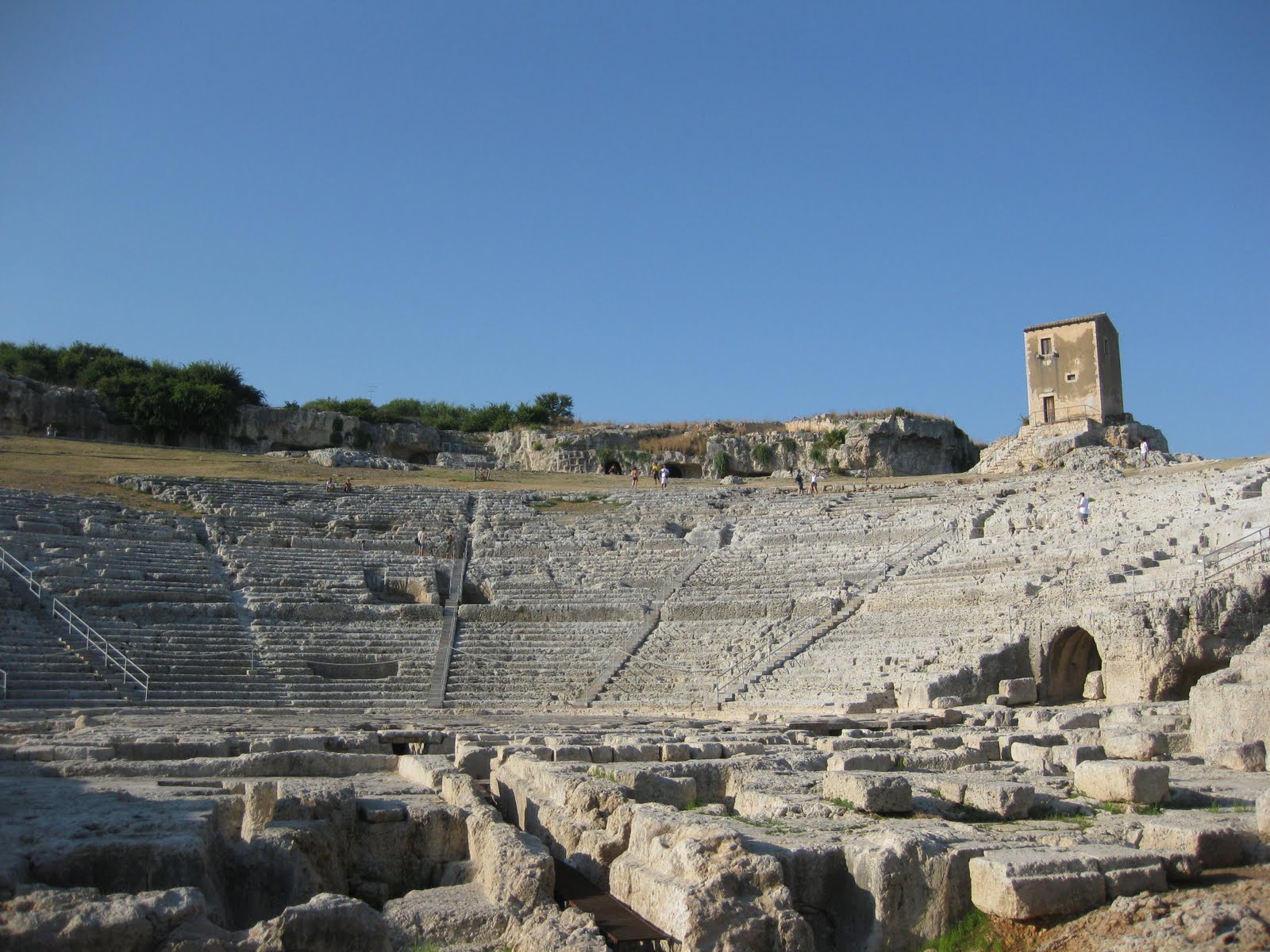
Later on that day we climbed the heights of Neapolis and I spent the afternoon just gazing awestruck at the rungs of the ancient theater opening into the horizon like a giant fan of pure spirit. The white stone pulsated with religious and rational energy. It is merely the face of a cruel quarry, but no matter.

As we were getting there driving through the multiple quarries of Achradina, some gaping ominously in their underground darkness, I thought I caught a glimpse (it was probably self-suggestion) of that other theater that the wretched Athenian captives had hewn in those infernal depths, simply to while away some hours of their living death by the sweet and invincible sounds of Sophocles and Euripides.

Both the victors and the defeated, separated by absolute and pointless hatred, worshiped at the same altar. How odious is human vanity, all the more so as the vain souls are equally giants of taste and desire and capable of scaling the pinnacles of thought. The foolishness of the great deserves so much more contempt. The above-ground faces of the quarries of Achradina were scintillating in the pure sunshine reflected off the calmness of the Ionian sea.

There was one jarring note. Right across from the Paolo Orsi archaeological museum (a true gem) there stands this ugly modernistic catholic church with a pyramidal roof rising to a stupendous height and thus brutally effacing the low-voice beauty of the surroundings. This insolent cement spear can be seen from miles around, another attempt by the Christians to impress their unnatural, perverted sensibility upon a historical and physical plate that simply chokes in their violent embrace.

Medieval morbidness, either of the Western or the Eastern Christian type, has simply no place here, or anywhere else in the Hellenic universe for that matter. It makes a mockery of all that the spirit of the Hellenes strove for, namely the spirituality throbbing at the very core of physical existence and deep within the human body.

But truly there is no more egregious manifestation of this Christian violation of Hellenism than the one seen on the acropolis of Ortygia, the heart of Syracuse. There the temple of Athena, one of the three erected in Sicily to celebrated the Hellenic victory over the Carthaginians in the battle of Himera, has been usurped and defaced in order to serve as the catholic cathedral of the city.

You can see and feel the mighty Doric columns of the archaic edifice, entombed in the superimposed medieval structure, still fighting to break loose from this deadly embrace. This is a spiritual atrocity that makes one gasp (I was the only one gasping). I suppose that the original Byzantine enclosure of the ancient temple would have been insensitive enough. But what intensifies the ugliness of the rape is the addition of that execrable Baroque facade that was erected in the Bourbon 17th century. The empty pomposity of its catholic "saints" in their faux tortuousness simply makes one cringe.

It is fortunate that the temple of Apollo, a few hundred meters up the street, although itself once subjected to the same sad fate of forced Christianization, has managed to get rid of this burden, probably through earthquakes that shook off those sick prostheses. So now its two remaining columns stand proudly alone to proclaim eternally their message of freedom. Athena, however, has not yet been liberated.

The island of Ortygia is a charmed world. An attractive village of Italianate refinement that blends well with the Hellenic aura surrounding it. Its main thoroughfare opens up to the spring of Arethusa and the great port, still populated by the suffering shadows of those Athenians sacrificed in vain.

Tuesday, September 13, 2011

A predicted debacle

As anticipated the ingenious "political" strategy of Greece's new minister of economics blew up in his face. That his personal standing was thus shattered is a negligible loss -nobody is going to miss the ugly mannequins running the show here for the past forty years when they are finally kicked off the stage.

The more consequential thing is that his attempted blackmail (see the previous post) precisely galvanized all those forces in Europe convinced that the country's place in the EU is plainly untenable. This conviction is now an iron-clad consensus and the only thing remaining is to work out the technicalities of Greece's ejection in such a way as to minimize the horrific consequences for all involved. This may take some time -a couple of weeks at most I reckon.

What may still save us for a little longer (i.e. a couple of months) -as a thoughtful colleague remarked this morning- "is Aristotle" and the fear of uncontrollable chain reactions in case the Rauswurf is clumsily handled. This last possibility has even roused the somnolent Obama people, who are sending their treasury secretary to Poland to participate in the meeting of the European finance ministers at the end of the week.

As for "Aristotle" what the friend meant to evoke is the immense cultural and historical significance of Hellas as a concept in the collective European mind. For those that admitted Greece into the Union back in the 80's and for a still significant segment of current opinion makers in the old continent, Europe is not just an economic arrangement but a wager in civilizational paradigm change, in which a new collective identity is to be built around the values of democracy, social and trans-national solidarity and critical historical thinking. And of course in all this one discovers Hellenic roots and foundations. Europe without Greece, thus, still seems to a lot of Europeans a truncated concept, a "body without limbs" as J. Delors recently expressed it.

For all of educated Europe Greece is a crown of spirituality that adds an eternal glow to the European institutional edifice, despite its having become an economic crown of thorns recently. Hence the last lingering hesitations concerning the (inevitable) exit of this failed state from the consort of serious, civilized countries.

When I say "all of Europe" I must, with heavy heart, exclude from this company the country named "Greece" itself -or, to be precise, its ruling elites and the greatest part of its population in its current numb and brutalized state, for whom the European cultural project as well as the Hellenic idea meaning nothing at all.

It is only the small minority of European Hellenes cowering in their hiding places that perceive the horrendous events unfolding these days as a cultural and moral catastrophe of unparalleled dimensions.

For the rest this society resembles but a ship of fools going merrily to its doom.

Sunday, September 4, 2011

An autumn of futility and despair

The weather is still hot and sunny, but the summer with its deliberate forgetfulness is definitely over. More about the remarkable experiences of this summer in future posts, but for now it suffices to note that we are back on the track of collective destruction. Our abject leaders, whom we had gleefully erased from our mental screens for the duration of a few weeks, are back with a vengeance and still bent upon their same old pursuits of dismantling the little that has been left of this place -and this applies to all of them.

The government is paralyzed. After the stressful days of June, when they passed in Parliament the tough measures demanded by the EU in order to continue to keep the country artificially alive, they reverted to their time-honored game of doing absolutely nothing in order to put these measures into effect. The idea is to give to the Europeans what they want on paper, and then to proceed to violate all these verbal commitments in practice.

No wonder that the latest round of negotiations concerning the progress of the (fictional) reforms supposedly implemented by the government collapsed in acrimony. The Europeans departed last Friday in disgust at the tricks of the Greek ministers and bureaucrats trying to evade their legal obligations. The fact is that no one in government, with the exception of one or two individuals, supports the goal of trimming the monstrous public sector, for this means going against their very electoral base.

The strategy of the new economics minister is "political". This amounts to a blackmail of the Europeans, to the effect that they should accept that no structural reforms (opening up the closed-shop professions etc.) will be carried through and that they should be satisfied with the savage reductions of the salaries and pensions of the weakest groups that have been imposed so far. So they should shut up and continue funding the obscene absurdity that is the Greek state sector, for if they refuse the bankruptcy of the country will sweep the whole Euro area away.

This gamble is certainly desperate, but it has to be admitted that it has its own implacable logic. As I have remarked in the past in a very real sense Europe is Greece's captive under the present circumstances. But of course if matters are taken to that extreme, then the "political" -again- reactions of the European political classes and electorates become highly unpredictable. In this climate the attitude may very well prevail that it is preferable to let Greece go to the devil (given that its ruling elites ardently desire it), with Europe then going through a sharp but manageable crisis with highly beneficial consequences for its healthy core in the medium term. Europe will thus be rid of a stone around its neck.

This kind of thinking seems to be gradually winning the day in Germany, despite the protestations of the likes of Helmut Schmidt, Helmut Kohl and Gerhard Schroeder. What also weighs in its favor is the fact that the other countries of the European periphery are following a course of genuine reform quite the opposite of the sham "corrections" effected here.

It could well be argued that that contagion is a real and present danger as long as an unreconstructed Greece of rotten and stubborn Sovietism remains inside the Euro system. Whereas if this abscess is lanced immediately by letting the country go bankrupt and kicking it out of the European institutions altogether, the healthy core of the European project will soon recover: this would be the Befreiungsschlag as the Germans call it.

I personally dread such an eventuality, for it would forthwith destroy this place as a viable economic and cultural concern. This society would immediately descend into the savagery of a Hobbesian state of nature, a civil carnage much more barbaric than the one we went through back in the 1940's -and then Europe would have another kind of problem in its hands. And yet this is the outcome that our present leaders are blindly steering towards. This seems incredible to the average rational individual observing events from the outside. But for those of us who have lived through the moral and political beastliness of the Greek system of the past few decades it remains, unfortunately, a probable denouement.

Wednesday, July 20, 2011

Back to the precipice

Back in January 2010 the sum that would have sufficed to bail out Greece amounted to around 28 billion euros, and a rescue plan of that magnitude was being readied as Le Monde reported. Germany torpedoed it. Today the cost, only for Greece, is roughly 200 billion and counting -not to speak of the dizzying sums that are also required to buttress the European southern periphery but also, conceivably, the healthier core of Euroland. But Merkel is still stalling, in full knowledge that another dud of a solution at Thursday's Brussels summit risks igniting a market stampede.

Why is she persisting with this wrong-headed approach? It could well be the dogmatism of the famed "Swabian housewife" which she is in thrall to, a fundamentalist protestantism of economic surpluses of the kind immortalized by Max Weber's great book with a generous dollop of memory of the runaway inflation of the 1920's thrown in.

But a true statesman cannot remain indebted to the past in this slavish fashion, for then he/she risks sacrificing the future of the substantial progress of European unity achieved so far. Whatever the truth concerning Helmut Kohl's reported thrashing of Merkel's policies as undermining Europe (and there is no smoke without fire, despite the obligatory denials) the real effect of her stubbornness seems to be exactly that. So much so that it gives rise to the suspicion that she has actually charted a non-European course for her country. This is the frustration reflected in Sarkozy's comments, reported yesterday in Le canard enchaîné, even though -again- the report may have been exaggerated.

For once the Greek leadership seems to be in the right in the current juncture: the Greek government has adopted all the harsh measures asked of it and at great political cost (they are not going to survive the next election, if things continue as they are today). It is now Europe's turn to devise a drastic and definitive solution to the debt crisis. It is simply unfair and also suicidal to keep harping on the deficiencies of the Greek tax-collecting apparatus as well as on the endemic populism of the worthless politicians here.

These things are true, they are the facts of life. But the whole thing turns on whether one will simply bow to the inevitability of their wreaking havoc with the European idea, or whether Europe will rise above them -even if this means in a sense rewarding the vileness of the Greek establishment (the proverbial "moral hazard"). At this point it might very well be that the price that Europe must pay to save itself is precisely taking upon itself the costs of the profligacy of the Greek establishment.

This is indeed morally outrageous and politically very hard to sell to the northern European electorates. But what if punishing the Greek kleptocracy with all the harshness that it deserves also involves the demise of the European project as a whole? Would the satisfaction of seeing the incorrigible Greeks stewing in their own juice (for they plainly do not want to be saved) be reward enough for the world-wide havoc that will ensue when both the Euro and the European union unravel? Only a fundamentalist madman would answer in the affirmative.

It is clear in retrospect that admitting Greece into the European union, and especially into the Eurozone, was a monumental mistake. But the clock cannot be turned back. And besides at that time nobody could have foreseen the utter degradation of Greek society following that admission -least of all thousands of people, such as myself, who abandoned careers abroad to join what we saw as the project of building a new society of justice and welfare here. All we can say now is that we were all victims of a noble illusion that soon enough turned into ashes.

On the other hand, the original architects of European integration plainly had in mind a process of political as well as economic unification as they laid out their plans. This vision was informed with the lessons of recent history, lessons much greater than the episode of astronomic inter-war German inflation that currently mesmerizes the ruling coalition in Germany. The goal was political and cultural and not just economic -and Germany herself declared as much when she incorporated her eastern territories at crippling economic cost.

It was clear from the outset that -to put it bluntly- if Germany were to mitigate somewhat the shame of her recent past she would have to pay through the nose. She would indeed have to become the paymaster of a united Europe with a European Germany in its core, which meant jettisoning the dangerous aspiration of a German Europe. As I wrote back in May 2010 Madame Merkel would simply have to shut up and pay up, if she still was interested in the European vision of Schmid and Kohl. The political implication of this was a move towards federalism or con-federalism on the institutional plane. The common currency was the opening gambit in such an evolution, and it is simply disingenuous to argue otherwise. If the Euro is seen as the end of an economic, rather than the beginning of a political, process it has no future.

Germany is, fortunately, strong enough to undertake this journey, however unpopular it may to the readership of Bild. It is powerful economically, politically and culturally. In a curious way Merkel's prevarications evince a pusillanimity at adds with the immense energy and drive at the core of the society that she represents. Her incessant to and fro is, thus, a betrayal of the best in the German spirit.

Thursday, June 30, 2011

The Guardian taken down the garden path

The London Guardian is one of the worthiest left-leaning newspapers around, but in the matter of the present Greek crisis it is patently ill-informed and ill-advised. It is fed information and analysis by people (including apparently certain "radical" circles in the LSE) whose ideas and practices do not offer a way out, but are rather the chief cause of the country's present predicament.

Its editorial today is partially right in stressing the tremendous burden imposed upon the average citizen by the latest slew of austerity measures. But it is entirely wrong in attributing this to a certain rigid mindset of international institutions, a kind of sledge-hammer conspiracy meant to bleed the people dry. In fact, these measures, and the ones first adopted in May 2010, were a (hasty and improvised) response to a situation due entirely to the outright criminal behavior of the local elites, who also managed to bamboozle the people into a hallucinatory state of "socialist" euphoria financed by the sweat of the German and French taxpayer.

And if this repulsive regime did indeed possess any actual features of legal and social equality, one might be able to defend it on some ideological grounds. But in fact it possessed none at all. It was simply a racket involving a tiny minority of party politicos, civil service unionists and owners of the main mass media here, whose purpose was to despoil the commonweal and suck out of it mythical riches for themselves and their henchmen. In this system the people were systematically fed ideological clap-trap, including a tremendous dose of anti-western and specifically anti-European venom, that exploited and reignited the political traumas of two generations ago, for the purpose of legitimizing their organized loot of state coffers.

This loot left all essential services in shambles: education was trashed, the health service degenerated into a major threat to anyone's health (biological, psychological and financial) who was unfortunate enough to become enmeshed in its coils, and all other public functions (tax collecting, building permits etc. etc.) mutated into gangs of blood-thirsty extortionists. European structural funds and mindless public borrowing at, then, cheap rates were used to fund the conspicuous consumption of the upper layers of civil servants and the functionaries of fictitious agricultural co-operatives, while everybody else was taxed to death in order to close the yawning budget gaps of state administration. In this manner Greece became the chief export market for the Porsche brand....

Under this ferocious assault of private interest against the common good (masquerading under hard-line leftism!) the natural environment, among other things, was terminally spoiled. Greece became a thoroughly ugly urban space with its entire cultural history effaced. This was an unprecedented act of cultural vandalism that went perfectly well together with the new mentality instilled in the average person, to the effect that "correct" ideological posturing and the right connections offered the best chance to participate in the thieving orgy.

It is this horrific system of rapacious hooliganism that collapsed with a sound heard around the globe. It is impossible for a well-meaning foreigner trying to make sense of the Greek situation from the outside and with the use of the the tools of rational political theory (of any hue) to conceptualize the devilish welter of corruption and the utter denial of any normal human value that was the "Greek system" over the past generation. It is still, I suppose, unbelievable to any sane civilized person that such things occurred. But to those of us who actually lived through this generalized psychopathology of feral grabbing it has been an unbearable everyday experience.

Hence the Greek case, although it affects Europe vitally, has absolutely nothing to do with the dysfunctions of global capitalism that caused the turbulence in the rest of the peripheral countries. Greece did not belong in Europe to begin with, not simply because of its defective economy (a kind of Brezhnevism under a pseudo-democratic facade), but also because of the mentality of its ruling elites, which saw the European project simply a a source of cheap money in their pockets and also as a tool for asserting their stupid nationalistic claims in their immediate neighborhood.

And this mentality, needless to repeat, was systematically inculcated in the mass mind, through the lying propaganda of paid agents of the corrupt system posing as journalists. Greece will be eventually ejected from Europe, because it has never wanted to be in Europe in the first place.

Given all this, it is easy to see how tendentious is another article in today's Guardian by a Greek journalist serving as the newspaper's current correspondent in Athens. Describing yesterday's odious scenes in Syntagma square she emotes about the beginnings of "revolution" in an "advanced democracy". This is just laughable.

Greek democracy has been a Potemkin village during the past generation. It was just a profusion of lying cant to cover up the plunder of the mafias in control of the state apparatus. Law and the institutions of legality have long ceased to have any practical meaning here, and everybody -high or low- is contemptuous of them.

This has been so since the beginning of the modern Greek state, but the past thirty years have brought this situation to its predictable conclusion, viz. the breakdown of the elementary preconditions for common life. We are currently going through the last, violent phase of this terminal anomie. This amounts to no "revolution" in any meaningful, rational sense. This society is slowly reverting to a Hobbesian state of nature. It is feeding off its own entrails, it is imbued with an irrational death wish, a fantasy of general conflagration out of which the raging mobs tearing up the center of Athens imagine that some nebulous "salvation" will emerge.

This is the ideology of certain apocalyptic sects that we know from past history. It is a bid for a full plunge back into the darkness of medieval fanaticism. The peoples of Europe have nothing whatsoever to learn or to hope from the current ructions in a place ironically called Greece. In organizing their worthy fight against the excesses of capitalism gone mad they ought to capitalize upon their valuable traditions of rational discourse,collective action and compromise for the general good which have long ceased to have any purchase in the political life of this country.

It ought to be stressed that a significant minority here is in full cognizance of the facts and the situations that I describe above. It would serve the Guardian well to seek them out for their insight.

Wednesday, June 29, 2011

Silence and shame

A couple of hours ago we barely avoided a headlong dash for the cliff -for the time being. But the lemmings are known to be stubborn little devils, and this society contains a sizable portion of them, a group moreover that is fired up by extraordinary destructive energy, so much so that they do provide whatever vitality is left in the dead limbs of its body politic. This is of course a negative vivaciousness, an urge for death, a brutal impatience for disintegration. To that extent it is a typical expression of the spirit of theological mysticism, which scorns the concreteness of the present, disdains the task of knowing it and reforming it, and instead delivers itself to a dark fantasy of otherworldly salvation presupposing the conflagration of the real, a colossal auto da fe.

This inflamed delusional state of consciousness is the bitter fruit of the cultural, political and economic regime imposed (in the name of radical democracy) by a small coterie of charlatans, dupes and demagogues, all of them in thrall to a mafia of brutal exploiters who proceeded to suck the very marrow out of the commoweal. It is these groups that are out in the streets protesting against the harsh measures needed in order to save the country from the consequences of their lying, looting and plundering.

There is no doubt that these measures are going to hit the hardest precisely those that had the least participation in the blood-sucking orgy of the privileged minorities. And the reason for this is that the representatives of the old order, inside and outside the government, fought tooth and nail in the past year in order precisely to frustrate the implementation of any structural reform.

Still, the masses of the people (crushed indeed by the one-sided attempt to rein in financial debauchery without touching the outrageous privileges of the mafias nurtured by statist collectivism) are silently watching the spectacle of self-immolation unfolding on the world's screens with the heartfelt wish for the defeat of these vipers currently parading under the pretense of "direct democracy". This is a sociopolitical fact that I trust will assert itself in the medium run given a modicum of sanity by all those in positions of power (however undeserved these positions). But of course there is also the possibility that precisely this modicum is lacking.

There are three distinct methods of approach to "truth" in physical and sociohistorical matters (each with a number of internal differentiations to be sure). The first is empiricism: one attempts to garner as inclusive a body of empirical facts and observations, concerning the matter at hand, as humanly possible. One then extrapolates from these evidences to the most likely generalization that can be erected on their basis. The second one is rationalism: one begins with certain rationally self-evident assumptions and then proceeds to deduce by means of correct logical procedure whatever other propositions follow from the initial posits. Both of these methods are ignored, violated, scorned and rejected by the vast majority of public players in the current Greek situation (not to speak of the populace subjected to their nefarious influence).

With respect to factual evidence, all opinion leaders here are complete ignoramuses in the fields that they are arrogantly pontificating about. They know nothing about cultural and political history, including the history of Greece itself, and they do not give a damn about it either. Engels said back in 1890 that historical materialism was simply an excuse for the "Marxists" of the time not to study history. This is absolutely true of this country today: the various ideologies that are passionately broadcast by the roaming bands of political vandals are simply covers for the most apalling ignorance of reality, an ignorance moreover that has been exalted to a positive virtue. The Marxists of all hues are devoid of knowledge of history, social structure and development, political ideas and methods -not to speak of economics. And the nationalists are equally heedless concerning nations, the Greek nation and their historical conditions and itineraries.

Rational argumentationa and logical coherence is also egregiously lacking on all sides. Let us assume that the prime concern at this juncture is to protect the people from utter impoverishment (as the representatives of the public sector mafias and their tools in the press claim). Then, how does this aim square with their demand that we should simply defy our creditors (who have been paying for their bloated bellies for so long), refuse to pay them back in any way, or adopt any measures of restructuring, with the result of being ejected from Europe and the euro? In what way would the people's welfare be secured with Greece tumbling to the level of, say, Zimbabwe? With a return to the drachma (touted by many, including Marxist "economists" as a patriotic goal) we would not be able to heat our homes come December.

Their "ideal" is, thus, a reversion to a subsistence economy of exchange in kind, a primitive communism of general destitution (one of Marx's worst nightmares). That real, living individuals would be thus forced to endure an actual hell with no foreseeable escape is, to these enthusiasts, neither here or there. For their real committment is not to people, but to their ridiculous "visions", the flights of their diseased imaginations.

And this brings us to the third way to "truth" alluded to above, which is the preferred one by these raving maenads of "revolution". And this is simply the "method" of mystical intuition, the revelation of higher, absolute truth by the supreme being that controls the unfolding of history, a divine authority that somehow speaks through their stunted and crude minds. What they believe is true a priori, even though it violates both the principles of logic and experience, simply by virtue of their claim that it derives from a secret source unavailable to common mortals.

This is the good old mentality of religious fanaticism, which (as I have explained before) has thoroughly corrupted the modern Greek collective consciousness since late medieval times (since the triumph of the Hesychastic heresy in the Orthodox church). This mental abomination continues to poison it, even though the content nowdays of religious belief is party politics rather than bona fide theism. And the cause for this iron grip of irrationalism is of course the fact that this society never went through the cathartic experience of the Renaissance or the Enlightenment.

In base Byzantinism all social and political questions were reduced to theological ones and the uneducated masses were brought out into the streets spurred by the eschatological ravings of uncouth monks: ζῆλος λήψεται λαὸν ἀπαίδευτον καὶ νῦν πῦρ τοὺς ὑπεναντίους ἕδεται as the church still boasts even today. Not a single day has passed, it seems, since those calamitous times, in which even the destruction of the Greek Byzantine state was preferrable for these lunatics to an alliance with the "heretical" west.

We are living through the same public dementia today. Europe will eventually eject this fake "Greece", not least because she yearns to be so ejected. The public mind here has drastically veered off any European, or even civilized, consensus as to basic values. The great crime of the regime that has so pitifully collapsed is precisely that it managed to excise any awareness of public duty from the mind of the average person. And all this, oh shame of shames, in the name of a hard core leftism!

"The best lack all conviction and the worst are full of passionate intensity": Yeats' immortal lines are constantly on my mind these days. With an amendment: it is not so much that the best lack convictions, but rather that they are totally demoralized as to the possibility of these convictions making the slightest dent in this torrent of mystical lunacy that seems to impell a whole society towards its own doom. The only thing left is to look on in silence and shame.

Sunday, May 15, 2011

Guardians of the temple


The glorious promontory still stands. The comings and goings of the foolish tribes of men (and women) have surely affected it, but they have not brought it down. For those who have eyes to see it is still sending out its signals. At this time of year it is in wild blossom, clad in the anonymity of its multifarious shrubbery as it cascades seawards. In the recesses of these bushes the grouse are nesting. Whole platoons of them walking up and down among the ruins, showing contempt for the camera-wielding hordes, climbing on top of broken columns, looking out to sea towards Salamis. They are the guardian spirits of this place. Being here one rises above the landscape and it modern scars. It puts you in the mood of forgetting; you do not want to know what you are going back to. The sea path is straight from here all the way south to the lair of the Minotaur. One feels like the aged king in his fatal watch, soon to die due to a mere inadvertence. He died but his name lives in these waters.

I wrote recently of the oracle of Apollo at Abae. The Thessalians destroyed it as they led the Persian host towards Delphi after Thermopylae. There was long-standing enmity between them and the Phocians defending their sanctuary. Herodotus relates that they offered rather generous terms of surrender to the defenders, including the promise to forget about the bad blood of old. The Phocians replied that they were not willing to "betray Greece". But the old fox from Halicarnassus is too shrewd to fall for the pious mendacity of the political orator. I am of the opinion, he comments, that had the Thessalians been on the side of the Greeks the Phocians would readily declare for the Persians, for their chief goal was to oppose Thessaly under all circumstances. Recently I wrote an article for the Athens Review of Books arguing that ancient Greek society does not in any way fit the nationalist stereotype of a homogeneous nation striving for a common historical destiny against its sundry racial foes. I could have used the above example as well to illustrate the point. The thought is a banal commonplace of course for someone who has the slightest awareness of the history and culture of the times. But it has caused offense here....

After the Thessalians had laid waste to the sanctuary and the towns of the Phocians, they marched on to Delphi that was their main target. That place was known to be stuffed with gold up to the gills, and Xerxes wanted to lay his hands on it. But Delphi was saved. Herodotus offers a tall tale to account for this outcome. The inhabitants of Delphi, hearing of the Persian advance, wanted to bury the treasures in secret places, but the God forbade them saying that he "can take care of his own". As a result the Delphians left and only a few priests remained in place. As the Persian contingent, led by Thessalians, appeared at the sanctuary of Athena Pronaea a number of miraculous appearances scared the pants off the invaders. To top it all there was severe thunder on the peaks above the temple of Apollo and huge boulders tumbled down the mountainside scattering the barbarian formations, which turned tail and sped away.

Now, is this the same Herodotus who made the hard-headed comment about the Phocians above? Can he possibly believe that it was divine intervention that saved the navel of the earth from the threatened sacking? Who can tell? The point is that in a cultural environment "saturated with myth" (as Paul Cartledge puts it), myth moreover that is taken as reality and probably has some roots in it, it is a major enigma how genuine historical writing could have arisen. But, maybe, Herodotus is justly considered the "father" of history precisely because he straddles the divide between the mythic and the political age; precisely because he succeeds in reaching beyond the mythical foundation of his consciousness in order to grasp the political foundation of human action and/or the political significance of mythic belief. In any case, wrapped in a hoary garment, factuality does rear its head in the Herodotean account. Herodotus is not lying, and the discoveries at Abae bear out his accounts. Maybe what we learn from Herodotus is how to reach the core of truth in myth.