Sunday, May 15, 2011

Guardians of the temple


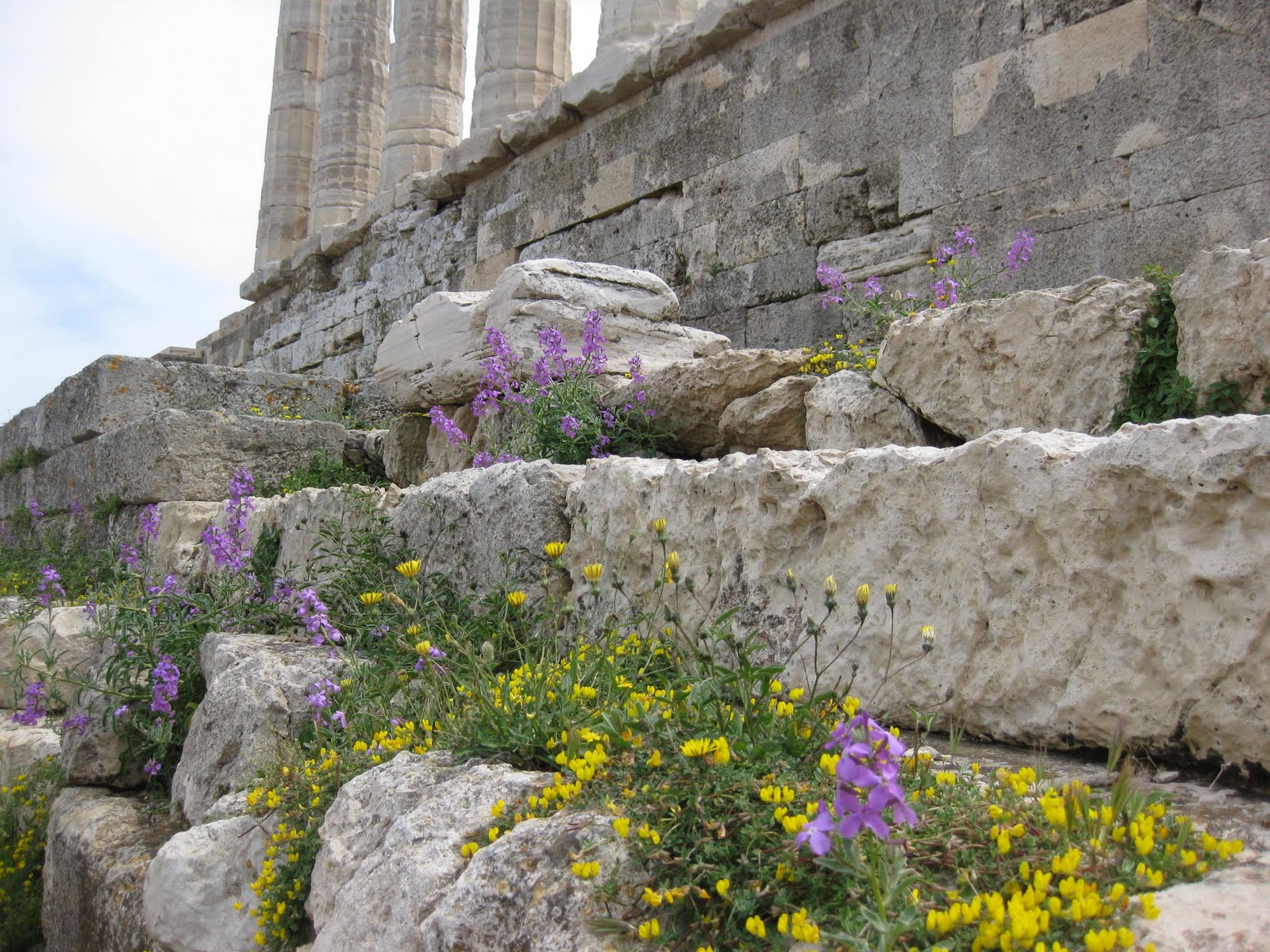
The glorious promontory still stands. The comings and goings of the foolish tribes of men (and women) have surely affected it, but they have not brought it down. For those who have eyes to see it is still sending out its signals. At this time of year it is in wild blossom, clad in the anonymity of its multifarious shrubbery as it cascades seawards. In the recesses of these bushes the grouse are nesting. Whole platoons of them walking up and down among the ruins, showing contempt for the camera-wielding hordes, climbing on top of broken columns, looking out to sea towards Salamis. They are the guardian spirits of this place. Being here one rises above the landscape and it modern scars. It puts you in the mood of forgetting; you do not want to know what you are going back to. The sea path is straight from here all the way south to the lair of the Minotaur. One feels like the aged king in his fatal watch, soon to die due to a mere inadvertence. He died but his name lives in these waters.

I wrote recently of the oracle of Apollo at Abae. The Thessalians destroyed it as they led the Persian host towards Delphi after Thermopylae. There was long-standing enmity between them and the Phocians defending their sanctuary. Herodotus relates that they offered rather generous terms of surrender to the defenders, including the promise to forget about the bad blood of old. The Phocians replied that they were not willing to "betray Greece". But the old fox from Halicarnassus is too shrewd to fall for the pious mendacity of the political orator. I am of the opinion, he comments, that had the Thessalians been on the side of the Greeks the Phocians would readily declare for the Persians, for their chief goal was to oppose Thessaly under all circumstances. Recently I wrote an article for the Athens Review of Books arguing that ancient Greek society does not in any way fit the nationalist stereotype of a homogeneous nation striving for a common historical destiny against its sundry racial foes. I could have used the above example as well to illustrate the point. The thought is a banal commonplace of course for someone who has the slightest awareness of the history and culture of the times. But it has caused offense here....

After the Thessalians had laid waste to the sanctuary and the towns of the Phocians, they marched on to Delphi that was their main target. That place was known to be stuffed with gold up to the gills, and Xerxes wanted to lay his hands on it. But Delphi was saved. Herodotus offers a tall tale to account for this outcome. The inhabitants of Delphi, hearing of the Persian advance, wanted to bury the treasures in secret places, but the God forbade them saying that he "can take care of his own". As a result the Delphians left and only a few priests remained in place. As the Persian contingent, led by Thessalians, appeared at the sanctuary of Athena Pronaea a number of miraculous appearances scared the pants off the invaders. To top it all there was severe thunder on the peaks above the temple of Apollo and huge boulders tumbled down the mountainside scattering the barbarian formations, which turned tail and sped away.

Now, is this the same Herodotus who made the hard-headed comment about the Phocians above? Can he possibly believe that it was divine intervention that saved the navel of the earth from the threatened sacking? Who can tell? The point is that in a cultural environment "saturated with myth" (as Paul Cartledge puts it), myth moreover that is taken as reality and probably has some roots in it, it is a major enigma how genuine historical writing could have arisen. But, maybe, Herodotus is justly considered the "father" of history precisely because he straddles the divide between the mythic and the political age; precisely because he succeeds in reaching beyond the mythical foundation of his consciousness in order to grasp the political foundation of human action and/or the political significance of mythic belief. In any case, wrapped in a hoary garment, factuality does rear its head in the Herodotean account. Herodotus is not lying, and the discoveries at Abae bear out his accounts. Maybe what we learn from Herodotus is how to reach the core of truth in myth.

Saturday, May 14, 2011

The temples are still blooming


It may just be that there is life after death. Or even that there is no death at all. What dies is what has been dead all along anyway. But what is left behind is that which is untouched by corruption. The eternal is all around us, except that we do not know how to see it.

What has passed for "Greece" up to now is dead, shriveling away into complete non-being. But the reason for it is that it was dead matter to begin with. Its institutions were a sham, a Potemkin-facade of public rationality, whereas in fact they were there to serve the most feral private greed. No public structure corresponded to its name or its concept. The more high-sounding the appellation, the baser the reality hiding behind it. Economy meant the plundering of the commonweal. Education meant the stunting of the critical faculty. Culture meant empty verbiage and the posturing of clowns. Politics meant the systematic rape of the res publica, of the common ousia, of the δημόσιον πρᾶγμα. Politics, especially, the highest of arts, was perverted into an obscene show of ideological obsession of all stripes, whereby various groups of self-intoxicated nonentities posed as saviors of humankind and in the process had no compunction to destroy everything standing (including real lives) in order to uphold their bizarre "visions". At the moment of writing they are still at it.

In trying to explain this outcome there is a long-term and a medium-term view. The latter is tedious, for it involves recounting the follies and crimes of various public actors over the last hundred and fifty years or so, which all conspired from diverse points of departure to render impossible a community of life in this land. Merely to think of them sullies and deadens the spirit. And in dutifully trying to single out the exceptions of intellectual and practical virtue (i.e. devotion to the common good) makes the whole enterprise even more unbearable. For it simply underlines the fact that the genius of this modern "Greek" system was always in trampling underfoot every manifestation of free and universal thinking.

The long-term view is more enlightening, for it deals with the grand historical forces that swept over this land tearing the heart out of its ancient culture and substituting a life-hating mysticism buttressed by the iron hand of despotism for the exhilarating, open-vista naturalism of the Hellenic era. This was of course the deed of imperial and theological Christianity -a Christianity, be it said, that had nothing to do with Jesus himself or even the message of the gospels. This radical rejection of classical Hellenism was of course prepared during the Hellenistic era, which under a veneer of Hellenization of the orient was in true fact a process of orientalizing Hellenism, i.e. imbuing it with the fanaticism of irrationality and the divinization of political authority. "Orthodox" Christianity was a child of this spasm of otherwordliness that electrified a decaying Oecumene. Constantine's victory at the Milvian bridge was thus the death blow against the difficult, tormented, inwardly torn but still magnificent freedom of the Hellenic spirit.

The Christian empire in the west was in time smashed by the Germanic barbarians -and that was a very good thing. A blast of frigid air came in from the dark forests of the north. The adopted religion of these Teutonic tribes was Arianism, a heretical form of Christianity which the surviving imperial authority was trying violently to root out in the Roman east. Arianism was a last-ditch attempt to preserve a modicum of rational sanity even within the context of the theological hysteria of Alexandrine apologetics. At any event, out of the Roman ruins in the west there would eventually emerge a new European culture of intellectual and ethical freedom premised, among other things, upon a rediscovery of the suppressed Hellenic values. The crucial fact here was that the monarchic claims of the "Catholic" church were energetically challenged by newfangled political communities giving precedence to their secular interests and objectives. The struggle between papacy and empire in the west was the beginning of a movement that would eventually eject theological intolerance from the steering booth of worldly governance. This was not meant to be in the Roman east.

There the unholy alliance, in fact fusion, between imperial despotism and a Christianity of hatred continued undisturbed through long centuries of moral decline punctuated by brief episodes of recovery. Social life was totally theologized, and the random sparks of rationality fueled by some remnants of Platonism were quickly extinguished. John Italos and Michael Psellos were persecuted as heretics in the 11th century. And soon thereafter the hatred towards Jews and other unbelievers, in addition to the internal heretical enemy (endemic from the beginning to official Christianity as a whole) was extended in the Roman east to the western Christians as well. The loathing became mutual of course and was underpinned by intense economic and political rivalry. It led to the massacre of the Latins in Constantinople in 1182 and the plunder of the same city by the crusaders in 1204.

In the rump of the eastern empire during its drawn out death throes the complete victory of monkish barbarity was sealed through the victory of the hesychastic movement in the 14th century. This cut off Greek-speaking Christianity from the emerging humanist movement in Italy. The opposition was significant among the educated and political elite of Constantinople, but the monks could mobilize the brutalized masses against the best in their society. The Palaeologian dynasty was western oriented as was natural for the pupils of the great Platonist and Hellenizer Plethon who had kindled in the scholars and rulers of Florence the enthusiasm for Hellenic learning. But the monasteries won, making thus sure that the country would be overrun by the Ottomans. The enlightened elements fled, and the obscurantists sealed their triumph by offering allegiance to the Sultan, and in so doing drastically extending their authority over all the Orthodox Christians of the Turkish realm. Plethon was duly anathematized.

The Ottoman regime was a Muslim theocracy, in all its fundamental principles a worthy continuation of debased Byzantinism. It rule was tyrannical and frequently violent. But the theological rulers of the suffering Christians could explain and justify that by the reference to the "sins" of the Greeks that brought about the fall of the Christian Empire. The greatest of those "sins" was precisely the effort to unite with Roman Catholicism. So slavery had to be put up with under a new despot who was in any case legitimate, having been given his authority over Christians by God. The ecclesiastical rulers adopted the title "despot" for themselves, a word that still today refers to the office of bishop.

The benumbed and benighted masses would henceforth bow and pray under the mantle of ecclesiastical despotism, now functioning as an official branch of the Sultan's government. Many among them would undoubtedly dream of the restoration of the east Roman theocracy. But the chief task now was survival. And thus the memory of Hellenism was completely buried, including that of the fitful Hellenic revivals during Byzantine times that constituted the doomed and transient glory of that era. The fake spirituality of the hesychasts now assumed even more beastly forms of superstition. This was the perfect counterpart of the murderous fanaticism of their Muslim dynasts. To the extent that the Orthodox populations yearned for liberation that meant that they simply wanted to be Turks in the place of the Turks.

Hellenism among Greek-speaking Christians revived during the 18th c. under the leadership of westernized intellectuals (many of the from the lower clergy). But this current of Enlightenment had no roots among the peasant populations. At the time of the Greek Revolution it furnished a political elite that spoke a western language of rationality and freedom thus legitimizing the uprising in the eyes of the fully Hellenized societies of western Europe. This caused the establishment of the modern Greek state. But soon afterwards, after its political use had been exhausted, it simply disappeared as a cultural force in the new kingdom. Popular politics quite naturally continued to flow within the age-hallowed riverbed of theological mysticism and fanatical hatred under a thin veneer of impotent constitutionalism and a national culture that was just empty rhetoric above the people's head.

In the twentieth century the newest import of Enlightenment ideology, itself pioneered by diaspora intellectuals, i.e. Marxism, inevitably enough mutated into a ruthless and murderous theology. And it was in this guise that it triumphed in the collective consciousness by century's end, incorporating in the process the essence of obscurantist nationalism that it had supposedly vanquished. It is this abhorrent hybrid of national stalinism that has ruled the country over the past generation and predictably enough brought about its moral and material ruin.

So now the matter is historically closed. The modern "Greek" state no longer exists as a going concern. It will of course continue as a facon de parler, a mode of political expression -but with no substance. And the only thing left to do, beyond basic survival which is becoming more problematic by the day, is simply an archaeology of memory and feeling -for those at least that are still concerned to preserve a modicum of their violated humanity. Layer upon layer of historical detritus has buried deep the shards and fragments of Hellenism in the land of its birth. Some of them are embedded in the language, itself wantonly defaced by the ride of the ethnostalinist Valkyries. (At least the Christians spoke good Greek -that much has to be conceded to them). Other remnants are hidden in the earth, some of them luckily protruding above them. And all these are still active, like seeds. Visit the temples and you will see: they are in glorious bloom. This must mean something. The soil is still being dug and that amazing past is still bringing forth its life-sustaining riches. The German Archaeological School has over the past couple of years brought to light the oracle at Abae in Phokis. This is a good omen. We do need an uplifting chresmos from the peaks of civilization. Not that anyone here has taken any notice, of course. But that is neither here nor there. Herodotos has been once again proven right. I have been reading him intently. He, if anyone, will help us somehow to survive.

Sunday, March 20, 2011

The wisdom of Robert Fisk. And its limits.

There is no doubt that Robert Fisk is the most knowledgeable, analytically astute and ideologically well-intentioned, as well as correct, of all the commentators on Middle East affairs.

And yet his latest comment in the London Independent concerning the military action just commenced in Libya does leave a few crucial questions begged. It is indeed helpful to underscore the duplicity, the hypocrisy and the naked militarism of past strategic interventions by the West in the Middle East that left the field strewn with countless innocent victims while at the same time empowering the very forces they claimed to fight.

It is also highly salutary to include in the crackpot leaders that the passions of the area throw up not only the usual suspects on the Arab side but also someone like Avigdor Lieberman, and by implication the entire Israeli extreme right effectively in power there at the moment.

It is, further, illuminating to emphasize that the western assessment of leaders such as Saddam and Arafat changed in proportion as these individuals either veered off from or alternatively capitulated to western strategic interests. These interests stayed pretty much unchanged over the past generation, remaining unswervingly inimical both to the aspirations of the Palestinians as well as the democratic yearnings of the Arab masses at large. He could have included in that list both Hamas, a creature of Shin Bet to counter the Intifada-minded PLO of the time, as well as the Afghan Mujaheddin famously praised by Zbig Brzezinski (mounted on a barrel) as the righteous agents of God -only to mutate later into the fountain of all earthly evil. Clearly Kadhaffi also belongs to this list.

But on the basis of this analysis it is not at all clear what the actual policy implications are for the present. There is a cogent case to be made (and it was made very eloquently by a distinguished spokesman of the left such as Michael Walzer) that despite past miscalculations and misdeeds the American military intervention in Afghanistan in 2001 was clearly justified, in law, in politics as well as in morality, and that if it had been pursued effectively Al Qaeda would have been obliterated as it ought to have been. The Iraq adventure, clearly misconceived as well as criminal on all the above counts, diverted resources and political energies from that legitimate target, leaving us with the present mess in both places.

It is true that the west went to bed with Kadhaffi after he renounced WMD and joined the anti-terrorist camp after 2003. But was this politically wrong under the conditions of the time? Even with the present hindsight it is not at all clear that it was. Kadhaffi continued to be the same crazed and odious ruler that he was before his about-turn. This is, and was at the time, clear.

But the suggestion that the foreign policies of the great powers ought to be based on the primary consideration of opposing (and overthrowing?) odious rulers is tantamount to the demand that the international arena should turn into a field of perpetual violent conflict -even if we assume that the criteria of who is odious and who is not are clear and settled.

The pursuit of morality and justice in international affairs is definitely a crucial consideration. But it functions within a constellation of other, pragmatic concerns. Each of these competing requirements ought to be assessed with a view to the general interest of humanity at any given historical juncture. The Stalinist empire was indeed as odious as they get, but the west was categorically justified in striking deals which legitimized its tyrannical control of Eastern Europe (such as Helsinki 1975), rather than attacking it outright. To avoid a nuclear holocaust was certainly a legitimate (and moral) goal under the circumstances, a consideration that trumped other pursuits (each one highly worthy in isolation), such as the forcible liberation of the "captive nations" as the extreme right demanded.

The Hungarians, in particular, paid for this dearly -but who in good conscience can say that the cause of human welfare and political freedom in Hungary and the world would have benefited through a military invasion of Hungary from the west to counter the Soviet one in 1956? How would the Hungarian nation be served by being extinguished along with many others? As it was the revolution was military crushed but was morally and politically victorious: there was indeed regime change in Hungary, for the eventual Kadar system (even under Soviet occupation) was vastly different from the Rakosi tyranny, even nursing the seeds of the overthrow of the dictatorship altogether in 1989. The logic of historical freedom is long-term and pragmatic policies are not necessarily inimical to it.

All in all, the morality of the politician, as Max Weber showed, is one of responsibility and not one of conscience, if by the latter we mean a stance of fiat iustitia pereat mundus. For if the world perishes, then so does justice. So the dalliance with Kadhaffi had things going for it, even though Tony Blair could have spared us the ostentatious embracing (Berlusconi is beyond the pale anyway) and Anthony Giddens the subtlety of his analyses of the "moderation" of the Jamahiria.

The point, now, with regard to Fisk is that the undoubtedly unpalatable prehistory that he brings out cannot predetermine present and future action. If the sins of the past and the uncertainties of the present mean that one cannot actually attempt anything for fear of going wrong, this signifies simply the forfeiture of political responsibility. This paralysis can only benefit the sundry monsters, filled with the "passionate intensity" that Yeats laments in his great poem, that the unchecked flow of life throws up.

The situation in Libya developed in such an unpredictable way that (despite Blair's and Giddens' missteps, not to speak of the institutional venality of the LSE) a threshold was crossed that made forceful intervention imperative. The ruthlessness with which the regime attacked its own population was clearly reminiscent of (if not on the same scale with) the events in Rwanda in 1994. That the Arab league came out backing the military imposition of flight interdiction and that the Security council provided the necessary legal authorization clearly distinguishes this case from Iraq in 2003. Fisk is right to underscore that military action had to be organized hastily and that it involves enormous uncertainties and risks with regards to the post-Kadhaffi era. But the alternative was to simply sit back and watch the regime squash its opponents under the boot like so many worms, "zenga zenga" in the Colonel's immortal phrase. These opponents are indeed not all saints as Fisk rightly reminds us. Still there is less risk now of the rebellion evolving into something equally or more nasty than the present government.

When the west was dithering the left was complaining that the only thing they cared about was Libyan oil controlled by their friend Kadhaffi. Now that it has intervened the same accusation is being leveled, i.e. that they went in to seize the oil. But if they had the oil under Kadhaffi in the first place, why bother take this highly expensive, dangerous and uncertain gamble? These are the stupidities that one hears here in Greece, where "anti-imperialist" demonstrations are being organized. One would expect such a response from the Greek left, which is definitely "the worst in Europe" as it has been correctly labeled. Fisk would do great disservice to his own intellectual and moral stature to fall into the same pit.

Wednesday, March 9, 2011

Finis Graeciae

I think it is safe to say that after one hundred and ninety years the experiment of modern Greece has, barring a miracle or two, finally failed. One, of course, still hopes against hope, for the realization of this finality weighs like a hellish gloom upon the soul. But these are subjective considerations. If one approaches the case in a sober-minded way, the evidence appears overwhelming that the project inaugurated in the early nineteenth century has run out of moral and cultural steam -the economic implosion is merely a side effect of this.

The phrase of the title was floated back in the eighties by a coterie of right-wing mystics to lament the incorporation of the country into the "Frankish" construct of united Europe, thus forfeiting its "Orthodox" authenticity and its folkish ways of a communalism based on blood ties and sentiment. At the very moment when the country was given its best, and last as it turned out, chance to shake off the torpor of traditionalism and the pettiness of personal kinship that trumps considerations of the common good and universal justice, this whining from the fringes became more and more persistent and acquired a wide audience.

In due time it penetrated the discourse of almost all segments of political opinion. It brought together a revived nationalism (that through this stratagem managed to jettison the legacy of the dictatorship precisely as it salvaged the core of its ideology of Messianic Greekness) and the unrepentant Stalinism of the left, who finally realized that they shared an enemy. And thus was engendered the monstrosity of an "Orthodox communism" or a "communist Orthodoxy" which considered their obsessive hatreds vindicated by the West's intervention in Kossovo, where the "imperialists" attacked a "fellow Orthodox" nation. Greek volunteers fought on the side of the Serbs in the killing fields of Srebrenica proudly raising the blue and white flag in celebration of that horrific massacre. And the few lonely voices that were raised here in protest against that indelible stain on the country's honor were shouted off the stage as agents of imperialism.

Today it is clear that the proclamation of the "end of Greece" has indeed come true, but for reasons exactly opposite of those alleged by its original authors. Greece has been finished precisely because that medieval mysticism and its "leftist" equivalent of a "people's commune" has swept away from public life all belief in constitutionalism and the rule of law as "western fictions" tyrannizing over the "soul of the people". One sees a direct parallel here with the visions of the Russian Slavophiles, denounced by Marx as reactionary fantasies for all the "communistic" pretensions that they also donned. The only "right" that has been left standing in this desolate social landscape is the brutal one of first possession, by those of superior might or political and personal connections. We are unmistakeably headed towards (if not actually in) a Hobbesian nightmare of morally unrestrained rapacity.

The political elites of the past generation are directly responsible for this state of affairs. They milked the European cow with gusto, using that largesse to fatten the cliques of their hatchet men that took control of state institutions -as well as their personal bank accounts abroad, of course. And they covered this up with a shrill rhetoric of "national pride" in combat with enemies at all points of the compass -beginning with weak northern neighbors and including the very Europeans whose subsidies made their debauchery possible.

They thus turned Greece into a pariah in the European system, claiming endless exceptions to European legal regulations that somehow threatened the domestic kleptocracy and broadcasting a retrograde nationalism that made a mockery of the trans-national (but not anti-national) comity that the European Union was trying so laboriously to forge. And this was the pitiful betrayal of that grandiose universalist endeavor that the revolutionary uprising of the Greeks symbolized, in the eyes of progressive Europeans and a part of the Greek elite itself, back at the beginning of the nineteenth century.

The tragedy of all this is that Greece had at its disposal a national myth among the most potent and vibrant of all national myths at the time. It was the projection of a destiny among the civilized (and Christian) nations of the west, whose culture had Hellenic foundations, that legitimized the political aspirations of those revolutionary fighters on the international plane. And it was to this vision, enunciated by Korais, but also by Ypsilanti and the first Greek national assembly at Epidaurus, that progressive Europe responded. This response, eventually maturing into a collective political intervention, actually saved the Greek revolution at the very moment when it had been extinguished on the ground, despite the magnificent epic of Messolongi.

But after that this nurturing national idea was systematically mismanaged and eventually botched. The European face and aspiration of Greekness was still alive in the official paideia of the nation through the nineteenth century. But in the course of the twentieth it gradually mutated into a particularist caricature of its original universalist inspiration. In this ideological presentation the Hellenic historical phenomenon, including the revolution, was systematically denuded of every European significance and dimension. European history was actually not taught in Greek schools, except incidentally as a tale of evil machinations against the "chosen race" and attempts to "steal" our cultural primogeniture (vide Elgin). This went hand in hand with the failure to construct a functioning civil and political society domestically. The greater the calamities heaped upon the Greek people by the incompetence and wrong-headedness of Greek politicians, the more ear-piercing the rhetorical shrillness of the official nationalism, attributing all disasters, external and domestic, to foreign causes.

We are at the present moment going through another bout of this collective hysteria, to which the Greek public sphere is characteristically prone. The cause is insignificant -but also highly revealing. A historical documentary about the revolution of 1821 is being shown on television, in which certain "sacred" truths are questioned (clumsily it ought to be said -but this is another issue) and the opinion of foreign scholars (among them a Turk, sacrilege of sacrileges!) is also aired. The crowd of intellectual thugs occupying the public sphere, the same ones raging against the "foreign occupation" of the country (meaning its financial rescue by the EU and the IMF), are up in arms denouncing the conspiracy (by Soros, the Freemasons, the Zionists and what have you) to rob us of our national identity.

The conclusion is sad but simple. The triumph of this degenerate nationalism is the result of the fact that, in the end, the modern Greeks have failed to become a nation. A nation is a community unified by common memories and sentiments, but also by commitments to political values and institutions that uphold the equal dignity and freedom of all members thereof. A national consciousness in its genuine form is a way of transcending private interest in the search of the common good, a mode of living together in mutual acceptance. And it does not imply contempt for other national cultures and ideals. This is the concept of the nation that springs from the writings of Rousseau and the experience of the French revolution, a notion that the leaders of the Greek renaissance of the 18th century subscribed to.

In contrast, the cult of "sacred" national symbols in present day Greece is mere rhetorical posturing and devoid of any moral or intellectual substance. It is a mere masque of hatred. In fact hatred has come to be the defining mark of this society, both internally and externally. Hence, the condition of latent civil war that defines its political and social life. It is in fact a non-community, an assemblage of particular associations ready to attack and devour those on the outside if the occasion presents itself and there is a prospect of success. Under these conditions "democracy" is simply a stalemate of opposing forces that are simply biding their time until given a chance to annihilate their opponents. The constitution and the laws are a mere sham, invoked as a pretext if it suits one's interest, but systematically violated to procure private advantage.

Greece has the most, the most complicated and the most wide-ranging laws (even some that are extremely enlightened), none of which is taken seriously or applied. The Hobbesian absence of law and right mentioned above is the dark reality underneath the legalistic facade. A statement by our comical "minister of justice" just a few days ago is indicative of the dominant ethos: when a person or a group violates the law, he pontificated in his usual asinine pompousness, "social realism" must be the guiding consideration. This means that if the law-breaker can argue that his/her circumstances somehow outweigh the obligation to obey the law then the crime is justified. This is the dominant attitude in this fake society. Lasciate ogni speranza chi voi entrate........

Dionysios Solomos, writing at the time of the revolution, expressed it trenchantly: if they hate one another they do not deserve freedom. I am afraid that he has not been proven wrong.

Wednesday, February 23, 2011

Lest we forget.......

Kadhaffi is at this very moment mercilessly slaughtering his own people with the help of imported thugs. The depravity of this act ranks high up there among the most vicious in the annals of human beastliness. It ought to be classified as an act of outright insanity. And the incoherent megalomania of the "brother leader's" rant on television yesterday was a shocking testimony to this.

It is useful recalling certain facts involving this monstrous personality, facts that shed light upon Greece's parlous state at the moment. Kadhaffi was the inspiration of the radical wing of the military mafia that established the dictatorship in 1967, and under the leadership of Brigadier Ioannidis pushed out Papadopoulos and assumed control for a few disastrous and blood-soaked months in 1973. One would assume that his star would wane with the fall of that regime. But alas that was not meant to be.

The klepto-socialist crowd led by A. Papandreou assumed power in 1981 by duping broad segments of the population (eager to be duped by any left-sounding charlatan anyway) with promises of "anti-imperialist" feats of glory. And immediately the new government established intimate relations with Libya. High ranking politicians and businessmen associated with the ruling "socialist" party established a dark web of connections with the Libyan regime, through which rumor has it that millions flowed into their pockets. And we all know that reality in Greece is much worse than any rumor. The right hand man of Papandreou in the dubious interlock with Kadhaffi is currently the president of the republic, periodically spewing pieties about the moral foundation of politics and the spirit of sacrifice that will get us through the crisis.....

In 1985 A. Papandreou himself paid a state visit to Libya accompanied by a fanfare of lying rhetoric about Libyan support for Greece's "rights" on the international scene (meaning Cyprus and Turkey) -a support that had never been expressed, and moreover would have been the kiss of death given the international climate at the time. Mendacious propaganda was also put about concerning huge investments that Libya was prepared to make to shore up the Greek economy. The Greek economy was also tottering at the time and was soon to be saved from bankruptcy through an emergency line of credit from the European Community (plus a hefty devaluation of the drachma). These were the first fruits of A. Papandreou's wasteful and corrupt economic management, which made the economy the private preserve of a clique of party apparatchiks and trade unionists thus laying the foundation for the utter economic and moral ruin that we are living through today. So the alleged Libyan rivers of gold were necessary in order to bamboozle the common folk and obscure from them the rapid descent of the country into a hell of rapaciousness and economic dislocation. During that visit an economic agreement was indeed signed that vaguely promised Libyan investments of up to one billion dollars in the coming years. This was advertised as a great achievement of the wise Greek leader through a nauseous campaign in the state-controlled media at the time. Needless to say, not a single cent of that billion ever materialized.

There was also another side to that masquerade of a visit. While in Libya A.Papandreou declared how impressed he was by the "democracy of the masses" that the mentally unhinged Colonel had established. He also had the temerity to claim that his "Jamahiriya" was the reincarnation of ancient Athenian direct democracy!!!! This outrageous elevation of Kadhaffi to a modern Pericles did not shock or disgust anyone at the time. The slimy journalistic establishment already feeding frenziedly on the state coffers thrown open for them by the Papandreou regime just fawned upon his inane pronouncements, without the least trace of that nationalist ire that they would exhibit in the nineties when the perfidious West tried to steal our civilization away in the case of Macedonia. But of course lucre goes a long way to assuage the malleable consciousnesses of our rotten opinion leaders.

Going to bed with Kadhaffi was presented by these apes as a robust demonstration of anti-westernism. And this at the very moment when the Libyan regime was veering off into multifaceted support for terrorism world-wide. All this had the political effect of isolating Greece within the European Community. Under Papandreou the country was forging a decisively anti-European profile in international affairs, at the very moment that it was being integrated into European institutions and becoming dependent upon the flux of European funds for the spectacular improvement of its standard of living.

This suicidal stupidity had already been demonstrated in 1983 when Papandreou was chairing the European council and in the matter of the Korean civilian airliner downed by the Soviets he came out with a declaration justifying the Soviet atrocity to the utter consternation of the rest of Europe. The "wisdom" of our great leader, then, amounted to spitting on the hand that feeds you. This lesson has been thoroughly learned by our current politicians in and out of government who are in competition amongst themselves about who is to insult and attack most vociferously the international institutions that are keeping this country alive.

Kadhaffi's days are numbered, although in the space of these few days thousands more innocent people are going to be mowed down by his assassination squads. But I am afraid that the spirit of Kadhaffism will live on.... Not in Libya surely, where the killer's beloved "masses" have tasted the bitter fruits of his bizarre "philosophy". But in other places and in other minds, where like a hungry garbage container all the detritus of 20th c. history, such as nationalism, Stalinism, anti-Semitism etc., has found friendly refuge.

Saturday, February 12, 2011

Rewrite your theories of revolution

Or, rather, throw them into the waste-paper basket. It should have been done after 1989, when a wave of ardent democratic sentiment swept away through entirely peaceful means (barring the dubious case of Rumania) the monstrous regimes of Stalinist brutishness. Or come to think of it, the operation should have commenced prior to that, when the tide of democracy upended the militarist tyrannies of Latin America in a manner emphatically opposite to that advocated by the Guevarists, whose gun-toting folklore actually provided the political rationale for the dictatorships and prolonged their rule. Chile even exited the bloodiest tyranny of them all by striking a deal with the tyrant that left him in control of a significant portion of power. This was not betrayal of any ideal, but a rational choice that actually furthered the interests of social justice and political freedom in the nation. And more recently we have been witnessing a radical leftist as president of Brazil inaugurating a massive process of renovation of the market economy, which drastically enlarged its social base and put the country at the forefront of economic growth and innovation.

These signal developments were however obscured by the murderous rampage of Bush's neo-cons in Iraq, who hijacked the concept of democracy as a smoke-screen for their sinister power grabs in the Middle East. This in turn provided the excuse for the sundry neo-communists in the West to privilege an ideological discourse concerning the evils of "globalization", a trick that aimed at justifying a political drive for class revolution, precisely of that same kind which had sucked the blood and marrow of the peoples of Eastern Europe for decades.

This "new" radicalism tried of course to decorate and obscure its theoretic antediluvianism by fancy Heideggerian and Lacanian verbiage -which ensured its capture of numerous academic departments especially in the US. But just as a lustful bond cannot be really hidden behind coy gestures, the political primitivism of these sophisticates comes forcefully through their mumbo-jumbo. And I suppose that we must be grateful to the crowned idiot of the aforesaid crowd, namely Slavoj Zizek, for at least being forthright about the mysticism of violence as an end-in-itself that lies at the heart of this "left fascism" (his term).

A couple of days ago he was ranting and gesticulating in his usual manner on Al Jazeera, praising the Egyptian people for their drive for democracy, a concept he despises and he has done his utmost to discredit in his dishonest ejaculations. But of course this is just about par for a person who has made quite a profitable profession out of blatant self-contradiction. In the same appearance he also had the temerity of blasting the institutions of international legality -he was scathing about Unesco (!!!!), the UN etc.-, shamelessly forgetting that the heroic throngs that were demonstrating as he was speaking were actually putting their lives on the line for the very ideals embodied in that (ineffectual, if you wish) international order. In fact one of their leaders was an eminent exponent thereof! Zisek's hypocritical praise of the Egyptians was actually an intolerable insult.

So now we have been blessed with the people of Egypt, who with their unbelievable maturity, spirit of sacrifice and ideology of togetherness have jolted us into renewed recognition of the essentials of humanity, thus putting to shame those false prophets of narcissist chiliasm. The Egyptian revolution was thoroughly, deeply, resoundingly, militantly non-violent, democratic, idealistic and universalist in its values -precisely all those things that Zizek and his ilk have made a career of mocking (let's not forget incidentally that he has called Gandhi more violent than Hitler and at other times Hitler not violent enough). It was precisely on account of this universalism that it was able to unite an entire people, beyond all divisions of class, education and creed. And this craving for basic human decency emerged spontaneously from the bottom of society.It flowered among the poor and the downtrodden and the persecuted, providing the torrential dynamism of their outburst. But it also penetrated the middle classes and the educated strata, drenching even the armed forces with the light of its moral vision.

Revolutions are not a street-theater of violence instigated and led by conspiratorial elites claiming to have divined the "deep truth" of history even against the collective consciousness and will of the masses that they claim to lead as by right. Egypt has killed once and for all this evil and murderous notion, which however still mesmerizes in the West certain privileged and pampered members of the very ruling classes that they make a show of opposing. Of course, this idea has been dead for a long time; but it has been rearing its vampire head again and again (not least among certain benighted groups in my own country). So, it is not useless to drive a stake through its heart every now and then. The wretched of the earth yearn for freedom under equal laws and for social equality and openness, and are no longer to be bought by the "visions" and the histrionics of various authoritarian personalities.

What the Egyptian people expect now is a democratic order of entrenched rights and social protection and an open field of social achievement for all. It is by no means certain that they are going to get it. The ancien regime is still powerfully rooted. But the promise and the prospect and the expectation is there, what with their new-found moral self-confidence and the whole world cheering them on.

And one last thing. The critical role that the new social media have played in the Tunisian and Egyptian revolutions is another proof of how outright blind and false has been this relentless invective against technology that we have been hearing for decades coming from these high-priests of Heideggerian, mystical leftism. If any decisive proof was needed that globalization, if understood in the completeness of its tendencies and dimensions, is not a dark and satanic force bulldozing under the just aspirations of the working masses, but actually an enlargement of human consciousness enabling the most far-flung networks of struggle and aspiration for justice and freedom, the events of the past month have been precisely such a proof. Wikileaks can also be added as a case in point. But, after all this is a diagnosis already made by Marx over a century and a half ago.

There will be many attempts in the coming days to hijack the meaning of the Egyptian revolution. The Islamists in Gaza and even in Iran are already making this effort. But I am hopeful that the Egyptians themselves will be the best guardians of its genuine significance, given the fact that in their exhilarating revolt of the past few days they gave no quarter whatsoever to such tendencies. The chagrin of Khadaffi, who even after the tyrant's ignominious flight dared to call Ben Ali "the legitimate ruler" of Tunisia, as well as the despicable reaction of Chaves' Venezuela, calling the Egyptian revolution a "CIA plot" to control the future of the world's peoples, are revealing signs that the waves of history unleashed on the banks of the Nile are threatening to drown all those defending systems of exploitation and unfreedom under the pretense of a fake "anti-imperialism".

The ideals of humanity are, thank God, irresistibly imperialistic.

Monday, January 31, 2011

Scary democracy

George W. Bush sent democracy to the Arab world dangling from the nose of a Tomahawk missile back in 2003. No wonder that the man in the street was not seduced by this poisoned gift. That some kind of open system succeeded the Baathist regime in Mesopotamia is neither here nor there, because this openness was bought at the price of vicious sectarian strife, brutal terrorism and civilian carnage. Yes, there were elections and the populace was excited to participate in the ritual; but for the American occupation this was just a sideshow and a mere gesture that they could not avoid, given their mendacious rhetoric. But democracy was not the point of the exercise, neither for the invaders nor for the various tribal and religious groupings jockeying for power. For the former it was strategic and economic control, given the fact that their former protege, i.e. Saddam, outgrew the role allotted to him as a bulwark against Iran. For the latter it was settling scores and mutual annihilation. The Arab world at large was not at all inspired by developments on the banks of the Tigris, as Rumsfeld and co. claimed (and maybe believed) it would be. This is not the kind of democracy that the Arab masses had in mind, i.e. a morsel of meat tossed at caged animals from the end of the occupier's bayonet. It would, thus, be an outrageous blunder to interpret the current revolutions in Tunisia and Egypt (and the ones brewing in Algeria, Morocco and maybe Syrian and Jordan) as a vindication of Bush's "crusade".

In fact the masses in North Africa have been fighting for their own kind of democracy for a very long time now, and always the West was adamantly opposed to these aspirations of theirs. At first the people were seduced by Nasserite national socialism and the third worldism of the Algerian FNL. But soon those fantasies mutated into the ruthless despotism of the new "revolutionary" elites, which pocketed the immense riches of their countries leaving their societies in ever deeper misery. The Algerian and Egyptian generals then changed tack and aligned themselves with Western interests in the area, posing as allies against "extremism". But domestic and cross-border extremism was precisely the result of their failure to create free and just societies at home. Whereas the West, blindly following a "security" imperative which is self-defeating when it goes counter to popular aspirations in the areas concerned, dug itself deeper and deeper in the hole of propping up tyrants that made a mockery of social justice and human rights. It thus ensured he abiding suspicion and even hostility of local grass roots democrats who endured repression and even torture under the Western umbrella.

The miracle of the current Tunisian and the Egyptian revolutions, thus, is the astonishing ideological and political maturity of the masses that have taken possession of the streets. Their demands are clear, simple and not in the least tinged by extremist undertones. This is their great, irresistible strength. All they want is a genuinely democratic order which will heed the aspirations of the brutalized underclass. They also crave the support of western peoples and governments in their struggle, so that they may eventually establish a truly equal partnership with them -instead of the despicable sponsorship of their tormentors that has gone under the name of "alliance" so far. If they succeed, this will constitute a mighty triumph of the best ideals of western civilization in the Middle East, of the very same ideals mocked and traduced by the short-sighted policies of raw military and economic power of western governments in the area.

And what of the Islamists? Have they just melted away? Certainly not. But as of this writing, they seem to have realized that the masses have not been demonstrating for an Islamist theocracy in the place of Mubarak's pharaonic (what an apt appellation!) rule. In Tunisia Gannouchi, the leader of Ennadha who just returned to the country, has been quite explicit in his rejection of the "integrist" agenda. His sincerity can only be tested in the open democratic arena. But I suspect that his democratic conversion is indeed making a virtue of the new cultural necessity. The young generation of internet savvy students and professionals that brought down the tyrant have actually tasted the fruits of unfettered freedom in cyberspace, and hence cannot be docile playthings in some project of demagogic mysticism. The social and cultural basis of Islamism seems to have been drastically eroded in wide areas. This was not the case in Algeria in 1992, when the brief democratic interlude that would indeed have brought the Islamists to power was stopped by the murderous onslaught of the generals applauded by the west. But if the Islamists had been allowed to assume power democratically, chances are that they would not have been able to establish a totalitarian theocracy, and in any case by now their power would have been equally undermined and superseded by the cultural development of Algerian society. Democracy may indeed throw up uncomfortable and even dangerous outcomes on occasion. But all in all it is preferable that its dynamic should be allowed to play itself out, for there is a high probability that it is self-correcting. But of course Algeria has oil and this was not allowed to happen. Islamism may still be the ruling hallucination in the barbaric wastelands of Waziristan, but it cannot appeal, I believe, to educated and historically conscious societies like Egypt, where the chief grievance is that the West is not true to its own ideals which these oppressed people actually uphold. This has also been demonstrated In Iran, of all places. The same open-minded, educated, yes even in the best sense westernized, youth (the great majority of society) almost brought down the regime of the Ayatollahs in 2009. They have a good chance of founding functioning democracies in North Africa -unless frustrated (God forbid) by some blind western reflex of discovering terrorists under every bed.

The same seems to be true of the Egyptian revolution so far. The Muslim Brotherhood is of course politically present. It has always been, despite the fifty-year repression it has endured -more precisely, just because of it. But it has thrown itself behind the broad and formless opposition movement that is not enunciating anything resembling the Brotherhood's ideals. Baradei, their chosen spokesman, is very far from being an Islamist. I was struck to read Robert Fisk's account of the Egyptian tumult in the Independent of London yesterday. He tells us that there was not a hint of either anti-Americanism or Islamist feeling in all the demonstrations he witnessed from Alexandria to Cairo on Saturday last -and this from the most severe critic of American policies in the Middle East. That said, it is conceivable that the more the stalemate lasts, with Mubarak clinging on by the tips of his fingers, and the western governments mouthing pious platitudes in order not to offend their trusted servant, a more extreme inclination might begin to take hold among the demonstrating crowds. Already on Sunday one could see homemade signs held up in Tahrir square sporting the tell-tale code words of Islamism, such as western "hypocrisy", as well as caricatures of Mubarak with the star of David on his forehead. Also some more beards have been appearing. But these things are at the moment negligible, and one hopes that they will not proliferate. It is clear that for this not to happen the "pharaoh" must go, and that the "orderly transition" that the State Department claims to want must involve a clean sweep of the old regime's personnel and repressive apparatus.

As for Israel, it ought to realize that a peace with Egypt is genuine and stable only if it is to be underwritten by a democratic regime clearly expressing the aspirations of the population. A private deal with a corrupt despot cannot be such. The democratic movement in Egypt has already shown such extraordinary signs of maturity that it is highly unlikely that it will elect to go back to a state of confrontation and war. Of course a democratic Egypt will be much stronger as a negotiator and/or partner, so that the extremist wing of the Israeli establishment will be in a much more difficult position in its attempt to impose its patently unfair diktat upon the Palestinians. If this causes unease among these circles, this can only be welcomed. One just hopes that American policy will not be once again hijacked by their reactionary stubbornness.

Long live the Egyptian democratic revolution.